
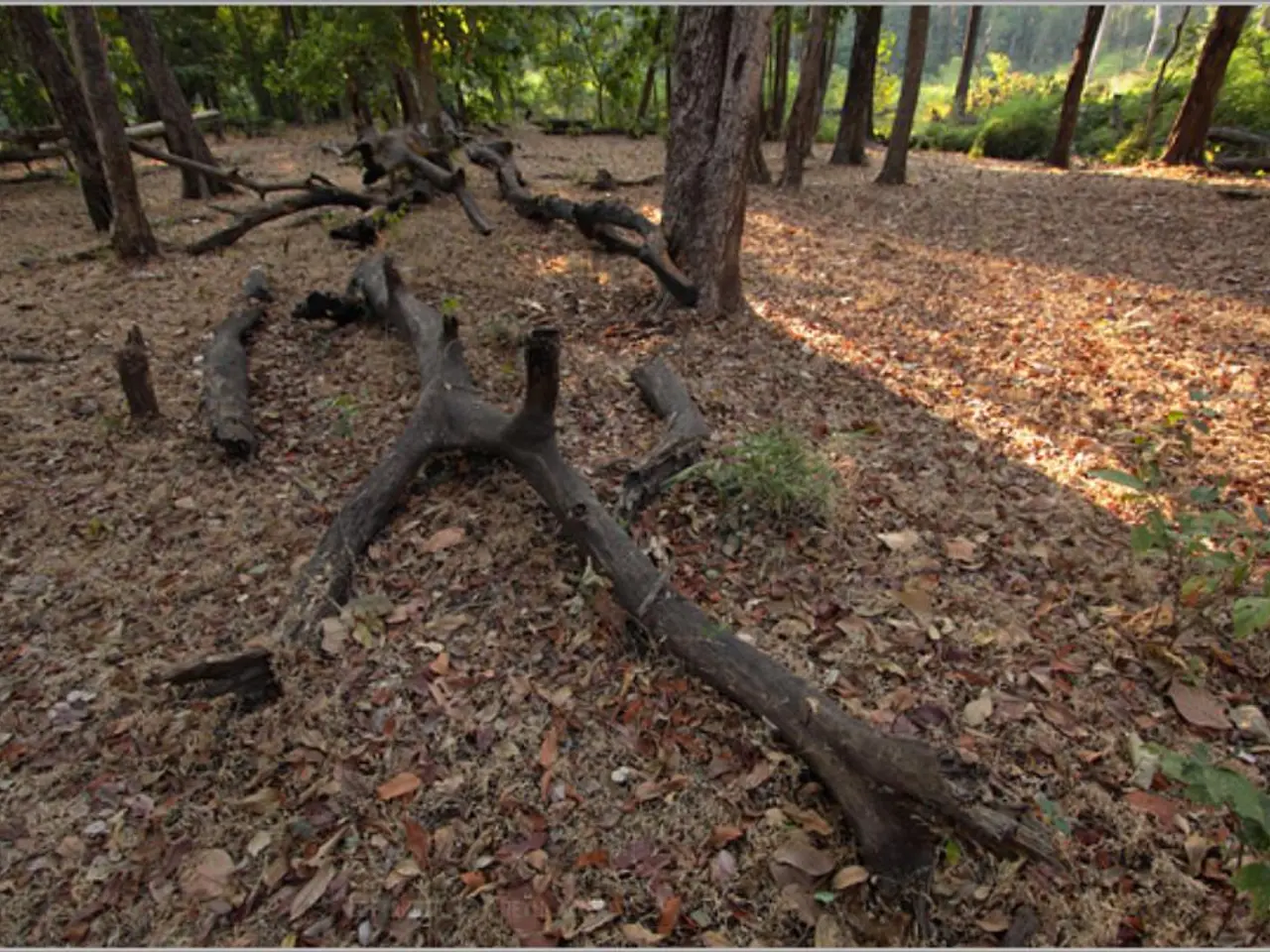
Accelerating Tree Trunk Nutrient Release in a Single Month: DIY Composting Guide
Want to enrich your garden soil and feed your plants with a fast, nutrient-rich compost? Look no further! With this simple guide, you can create a compost pile from tomato vines, grass, and dry leaves using a special microbe starter solution. Here's how:
Layering Materials with Proper Ratios
- Start by creating a 4- to 6-inch layer of dry leaves (browns) as a carbon source. Break them into smaller pieces to speed decomposition.
- Add a layer of green materials like fresh tomato vines and grass clippings, which provide nitrogen.
- Alternate layers of browns and greens, maintaining roughly 2 to 3 times more browns than greens by volume to balance carbon and nitrogen and avoid odors.
Add the Microbe Starter Solution
Spray or mix in your special microbe starter (a microbial inoculant) at each green layer or evenly throughout the pile at the start. This introduces beneficial microorganisms that accelerate decomposition and improve nutrient cycling.
Moisture and Aeration
- Moisten the pile to about the dampness of a wrung-out sponge—not too wet or dry.
- After piling, cover the compost loosely to retain moisture but allow airflow.
- Turn the pile every 1 to 2 weeks to aerate it, which is essential for microbial activity and faster breakdown.
Pile Size and Temperature
- Build your pile approximately 3 feet cubed (or larger if space allows) to retain heat, which promotes rapid microbial decomposition and pathogen kill-off.
- Monitor temperature if possible—aim for 110 to 160°F for “hot composting” to speed the process.
Chopping Materials
- Chop tomato vines and leaves into smaller pieces to increase surface area and quicken decay.
- Avoid woody branches in fast compost as they slow the process.
Timeline and Use
With good microbial inoculation, moisture, aeration, and balanced layering, you can expect nutrient-rich compost in 4 to 8 weeks. The finished compost should be dark, crumbly, and smell earthy.
Summary Table
| Step | Details | Notes | |----------------------|-------------------------------------|----------------------------------| | Browns | Dry leaves, twigs (4–6 inch layer) | Break into small pieces | | Greens | Tomato vines, grass clippings | Chop finely | | Ratio | ~2-3 parts browns : 1 part green | Keeps pile balanced | | Microbe Starter | Spray/mix during building | Accelerates decomposition | | Moisture | Damp as wrung-out sponge | Adjust if too dry/wet | | Aeration | Turn pile every 1-2 weeks | Maintains oxygen flow | | Size | ~3-foot cube or larger | Retains heat for hot composting | | Temperature | 110 to 160°F | Promotes fast, pathogen-free breakdown | | Time to Finish | 4–8 weeks | Depends on maintenance |
By following this method, you will create a fast, nutrient-rich compost pile suitable for enriching garden soil and feeding plants.
Additional Tips
- The top layer of the compost pile should be kept underground or under old compost to retain moisture, nutrients, and deter pests.
- The starter solution can be optionally enhanced with herbal tea, buttermilk, humus, or poultry manure to increase the diversity of bacteria and fungi.
- The compost made from this method can be used as fertilizer for the next spring.
- The compost mix should contain at least 10% soil or old compost.
- Using too much brown material won't affect the quality of the compost but will slow down the process.
- If the compost pile has an excess of green material, nitrogen may escape, but fertilizer can still be obtained.
- The compost process can convert tomato vines, grass, and branches into nutrient-rich fertilizer in just 30 days.
- The "starter" solution for microbes is made by dissolving 2-3 tablespoons of sugar in a liter of warm water (38-40°C), adding 0.5 kg of fresh yeast, and activating for 15-20 minutes.
- Too many brown components can be compensated with nitrogen fertilizers or high-nitrogen organic materials.
- For a quick composting process, the pile should be above-ground, well-ventilated, and at least 1×1×1 m in volume.
- Using too much green material can make the compost smell and lose its nutrients.
- The starter solution should be used within two days.
- By following these conditions, a fluffy, dark, and nutrient-rich compost can be ready for use by spring for planting.
- Piercing the ready but dry pile with a shovel or stick and moistening it with the starter solution is an option if necessary.
Create a home-and-garden compost pile that not only enhances your garden soil but also feeds your plants effectively. By following the given steps, you will generate a lifestyle-friendly, fast, and nutrient-rich compost. This can be achieved by layering materials with proper ratios (approximately 2 to 3 times more browns than greens by volume), showering in the microbe starter solution at each green layer, and ensuring the pile is neither too wet nor too dry while allowing for ample aeration. By incorporating tomato vines, grass, and dry leaves, you are ensuring a balanced carbon and nitrogen source, leading to an earthy smelling, dark, and crumbly finished product in just 4 to 8 weeks.